Wednesday, 11 May 2016

Just Moseying

Wednesday May 11

Awake early, after a very early night by my standards, I again tried to write yesterday's account and to upload photos to my Blog. So frustrating, this broadband is very slow and keeps cutting out.  It was good to begin with.....
I've actually finished it this evening - playing games between uploads.
Just as well that we didn't do much to-day. A long day yesterday, another to-morrow and then the lengthy drive to Skye on Friday. We drove to Salen, listening for Grasshopper Warbler in the reedbed across the road from here. Nothing apart from a Chiffchaff, our first since the Borders. Eiders, Red-breasted Merganser, Oystercatcher and Sand Martins on the Salen estuary. Then, across to the west coast and lovely Loch Na Keal. A stiff breeze this morning, producing white horses, still another scorcher. We stopped beyond the White-tailed Eagle parking spot, which was full anyway. Pam saw a Golden Eagle rise above the mountain across the Loch whilst a Sedge Warbler sang from the small reed bed and a Great Northern Diver showed briefly. This hot weather seems to have sent them onwards.
As we were about to drive on, an adult White-tailed Eagle flew medium height across the loch towards last year's nest position. Cruising the ridge, a Peregrine which had been hassling it, made an awesome stoop from high above. Brave bird. Or foolish. The eagle disappeared from view. Lovely experience.
Another of Arthur Brown's stopping places eventually came up trumps. We stayed here for an hour, watching six Whimbrel fly onto the rocks, Red-breasted Merganser and Great Northern Diver in the bay and another White-tailed Eagle, its huge wingspan obvious even at the distance and height at which it was travelling. It was going in and out of cloud as it spiralled away.
Then... the local Goldie took flight, giving lengthy views as it left the crag, gathering speed along the edge, before rising on the thermals. 
The drive to Calgary Bay is very scenic. Road clinging to the cliff edge in many places, metal crash barriers protecting from the drop onto the rocky shore - not many passing places either. Fingers crossed that one doesn't meet anything, we didn't to-day.
Calgary Bay features on many a picture postcard. The only lay-by possible for loitering to take photographs, is not in the best position. A woman in the car in front, leant out of her window to take a pic as they were driving along. Wish I'd thought of that. 


 We missed the turning to Caliach Point, thought to be the best sea watching place on Mull (Gordon Hamlett). We love it there. We had to turn back, no wonder, the road isn't sign posted but it's the first left after the Calgary tearooms. My exercise for the day was getting out to open and shut the gate across the road, part of the way down.
We then sat at the end, overlooking a loch, Ardnamurchan visible across the water. Just the sheep, lambs and us in the blazing sunshine and blue sky. We wrote postcards and read for almost two hours. So lovely.

We put the moth trap out last night and again, it started whistling after about five hours. That battery must not last the night. Cathy told us to put it on mains supply to-night, we're off to do that as soon as I've finished this. Not many moths trapped under a clear sky last night. 2 Common Quaker, 1 Clouded Drab, 2 Yellow-horned and one Spruce Carpet.

Tuesday, 10 May 2016

Dolphins on the Starboard Bow

Tuesday May 10


What a great trip. We went out ftom Tobermory on a Sealife Surveys vessel to-day. So warm that we sat in short sleeved blouse until lunchtime, when we hit a  more exposed area. The first hour or so is largely birdless, with the opportunity of seeing Tobermory from the sea - the best way to view the rows of colourfully painted buildings clinging to the mountainside. The top tier have started painting in colours now. A particularly vicious mustard yellow and a lavender standing out.
Pam saw our first Mull Dipper from the pontoon walkway to the boat - I was returning from registering with Richard.
The White-tailed Eagle's nest on Ardmore Point is even further back and, almost invisible, this year. 
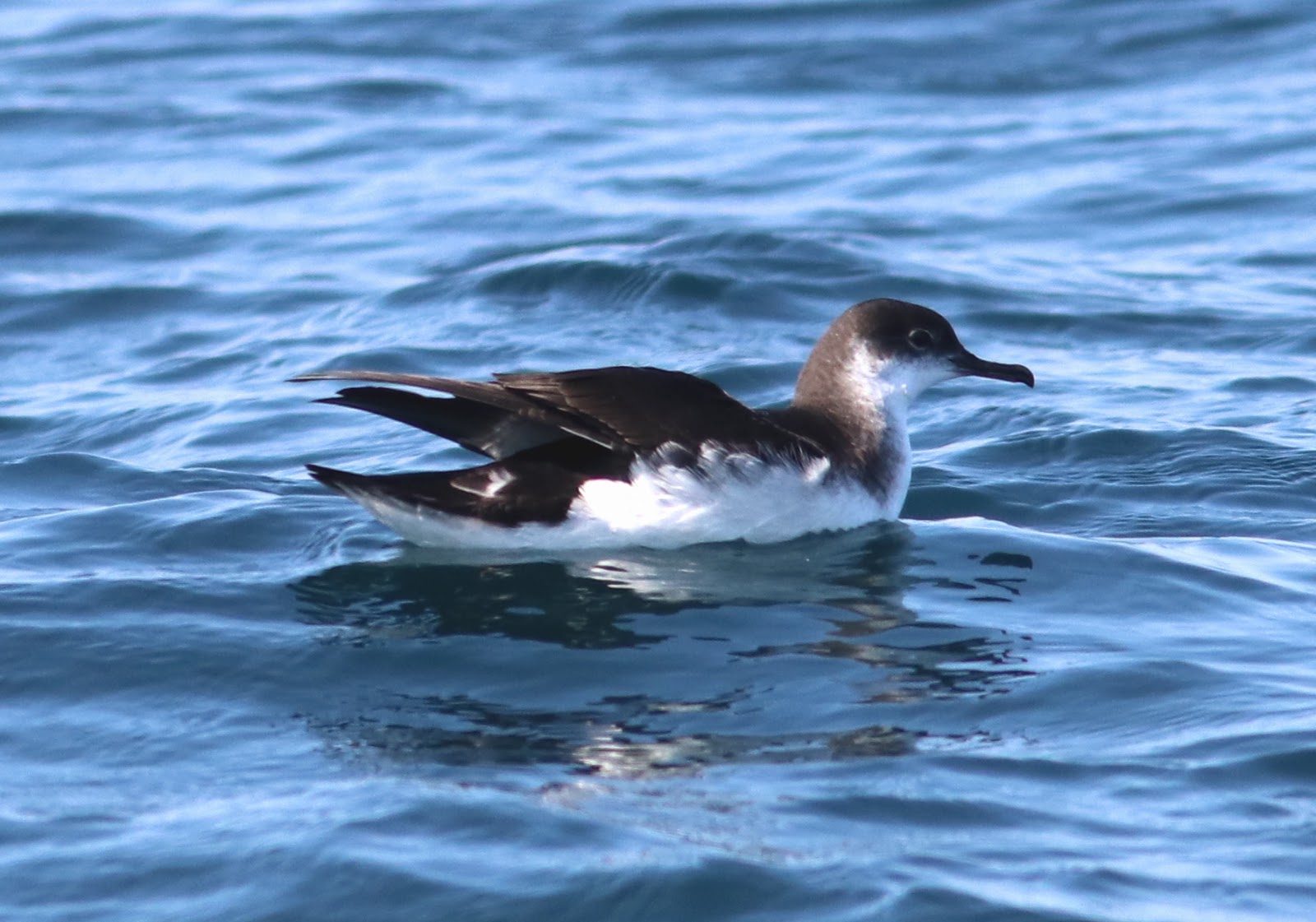
The first excitement was seeing a Great Skua flying strongly from the right before crossing the bows and flying away. Good views for everyone. Then, half a dozen Manx Shearwaters wheeled on the left. One of my favourite birds. Such beautiful flyers, graceful and apparently effortless, alternately showing pale underside and black upper, often close to the waves.
A film crew looking for Dolphins had departed just before us. A woman whose name I forget, but she appears on Springwatch and was on the Sir David Attenborough 90th birthday tribute programme the other night, was amongst them. They contacted our skipper to say that they'd found some Common Dolphins and that the pod was heading in our direction.  A fair bit of milling about then went on - for what seemed like an age - before the small pod was sighted. We had lovely views which were not photographable. I tried but got empty sea or a small fin. 


One view of two animals surfing a wave together remains etched in my memory. I've seen Common Dolphins several times before, they are always a delight and much anticipated. Those grey brown, smooth, muscular  torpedoes, always look as though they're having fun.  We did actually have four more dolphin experiences during the day out, all of them a joy.
Here's to the next time.
As we hit an upswell where currents meet up beween the jumble of islands, Rhum, Muck, Eigg, Jura and Coll to name a few..... the numbers of Shearwaters increased tremendously, huge rafts of them sitting on the sea, our presence startling them into splashing flight. I had a great time trying to photograph them, the violent pitching of the boat not helping at all. 


After more cruising about amongst smaller isles and rocks, Common and Arctic Terns screaming overhead, the boat stopped for lunch off the Cairns of Coll and a white sand shell beach. Lovely. They used to put people ashore but no longer. Other tour boats started copying and the nesting birds were being disturbed, still are although Sealife has desisted. The constant, if gentle, pitch of the boat, was not comfortable, appreciating the scenery helped. The many blue shades of the sea, from dark to Caribbean turquise with patches of deep purple seaweed showing under the surface. The rocks with a three foot fringe of weed - dark waterline, it was low tide, yellow lichen on the smooth surfaces, topped with mainly white flowers with some blue patches. A form of thrift I think, Pam's going to look it up. Must be tough to survive here. 


  A few Arctic Terns were nesting, we saw a Common Sandpiper too, amazing.


Time to set off - and Pam called a Minke on the north side of the boat. I saw it too - badly - only one other did. Another slow search and wallow, the many Shearwaters and small rafts of Guillemots were of constant interest. Many of the Guillemots were juveniles or still changing from winter plunage.

In total, we had four Minke Whale sightngs on the return journey. Two of them really close, no more rthan 50 metres away. Awesome. One can only guess at their actual size, as only the back and dorsal fin shows. I know it's a 'small' whale but that is in comparison with others. I managed a fin.


The last experience on this very good trip was of a White-tailed Eagle, high above the boat in the nesting area.
Debbie, whose first trip as a guide it was, did the Professor Plankton bit on the way back - he was on the film crew boat - showing close-ups of the plankton she'd trapped trailing a mesh cone behind the boat. The plankton rich waters is what makes the area so attractive to cetaceans.
Thanks to the very young (!!) crew and guides who were pleasant, helpful and informative throughout.


,

Monday, 9 May 2016

On To Dervaig


Monday May 9

An alarming morning. The house fire alarm started going off before 7 a.m and continued to do so in ever shortening bursts as John struggle to cancel it. He thinks a guest must have been smoking in the bedroom. We think it was the lone man with a kayak on top of his car.
Then we were told that the trap battery emitted a high pitched whistle in the night which woke Jane, who's a very light sleeper. She woke John and insisted he deal with it as he is 'the man of the house'. He unplugged it at about 2 a.m. Embarrassing, but they were ever so good natured about it. To our faces anyway. To boot.... the trap only contained two Caddis flies.
 After packing and visiting the shop for postcards, we left at 9.15. Our last visit to Fidden for another year, we love it there. The north of the island is better all round but we would not forsake Fidden. I've never seen a fuller tide, it filled all the creeks and covered the rocks, to the detriment of birds. It did look stunning. The ever present Dunlin, Ringed Plover and two Whimbrel. 
The Ringed Plover look very bright, are they the northern sub-species?


The bonus was our first Snipe startled into flight by a walker. They breed in the iris beds and are hard to find.
Arriving at the T junction we met the P's driving into the car park, in a hurry as they wanted to catch the Iona ferry which was just drawing in to the jetty. I hope they got it - and saw Corncrakes well.
The lambs look much fitter this year after a better winter for the grass. The rams look awesome. I love the mountain sheep with their black faces and legs best. We are now seeing the less than lovely large white breed with an unattractive face, brought in to increase the meat yield.


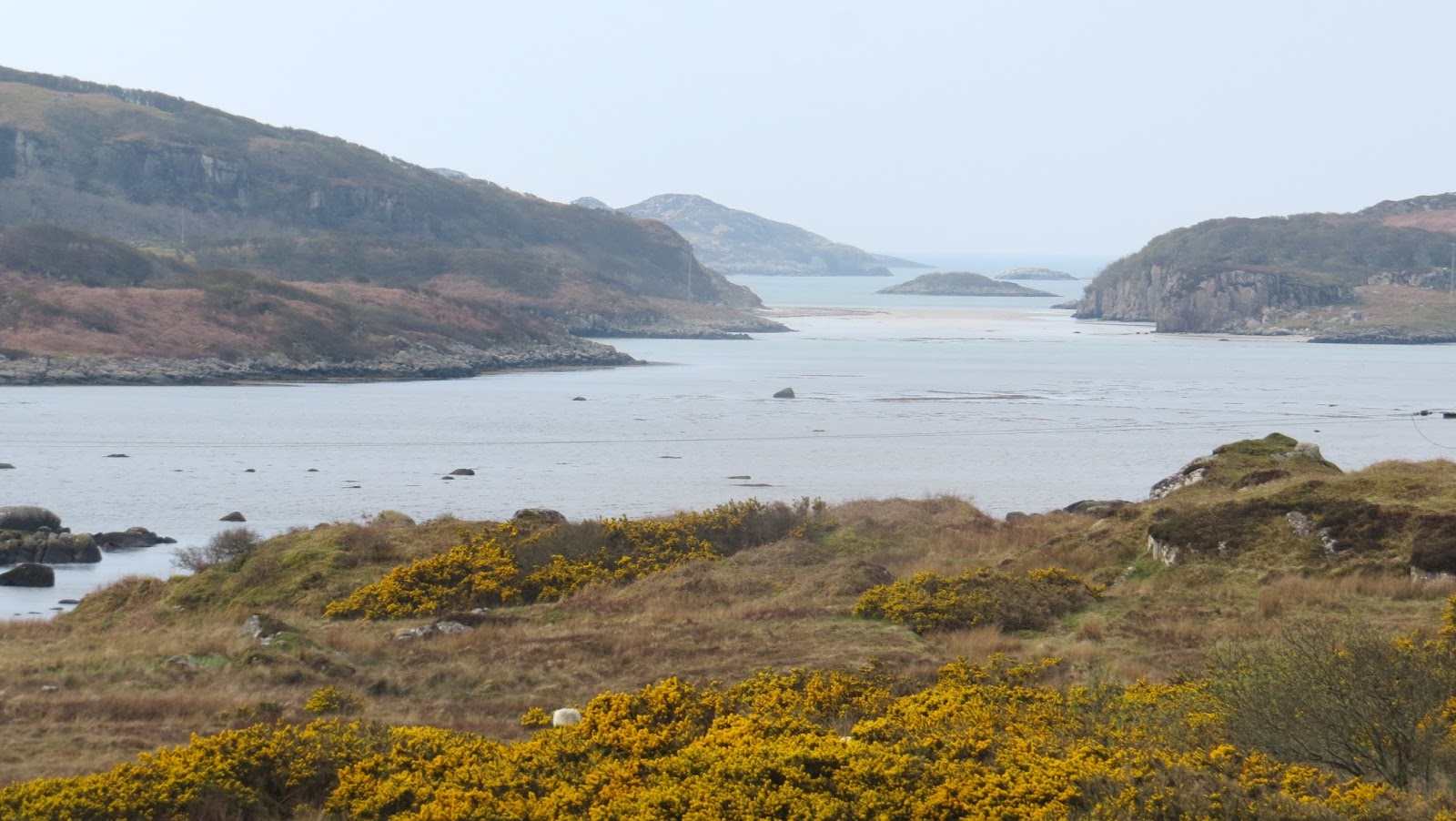
We took the slow route to Dervaig, around Loch Scridain and Loch na Keil, scenically stunning on another hot and cloudless morning. Not perfect as the sunshine was hazy. At last, a Whimbrel allowed me to take a decent photograph with the light absolutely right.


Petrol and a shop visit at Salen, lunch overlooking the estuary past the rotting boat hulks. Red Breasted Mergansers and Eider, a nest building Willow Warbler, collecting feathers before flying quite a way to the house on the hill behind us.
We needed to visit Tobermory for provisions for to-morrow's boat trip. Stugeron and Sun Lotion particularly, plus something for lunch. It is an eight hour trip. I got a message from Richard to say that the boat would be leaving later to-morrow morning. Fine. Both my pager and my phone burst into life at Salen. May 1st  messages on the pager and a text from J, who has arrived on Uist to-day.
We had to wait for the chemist to open, lunch hour closing ! We got what we needed before driving to Glengorm Castle. Ravens at the town dump as always, the latter a blot on the beautiful landscape but soon left behind. I bought a book on the Uist Ferry last year, written by a woman who had left a Suffolk Farm for a castle in Mull, via Dervaig first. We know that her son has taken over the Sealife Survey vessel from his father and they sold the castle. Her inlaws who she had escaped from, followed them here and moved to the 'house at the gate' of the castle. I had fun picking them out. The castle is no longer run as a hotel but as a restaurant, we had an iced coffee and a cake sitting at an outside table. The menu looked good and the situation lovely, all meat resourced on the estate. Unfortunately they close at 5 p.m.
I barked up the wrong tree there. The place they bought is 'round the corner'. 

The track to Loch Frisa has really deteriorated. We lurched and pothole dipped our way to the pull-off where I did the word games and Pam looked out - successfully. A female Hen Harrier showed above the rocky ridge. 
Time to go on to Cathy's. The historic 'pencil' tower on the church is encircled by a network of scaffolding. Must ask her why.
The design of the 1904 tower was based on Irish watchtowers such Cashel, Enniskillen, Clonmacnoise and Kilmacduagh, though here the tower was not free-standing, instead forming the west end of the church.
We had a wonderfully warm welcome and a hug and catchup from Cathy. She feels like we do about Blake and Sheila. Bliss to be shown to the room we always have, unpack and relax. The WiFi here is brilliant in comparison.  Fingers crossed that it continues.
Cathy now has a 13 year old miniature donkey which she put in a field with an orphaned lamb to keep it company. The donkey, Lily, often makes a helluva racket because the lamb keeps hiding from her. It's entertaining here. 


Sunday, 8 May 2016

Hotting Up

Sunday May 8

After very little sleep, a 7.30 breakfast came too soon. Sheila and Blake joined us again - Pam looked in the visitor book when they'd gone to find their names. When we asked John where he suggested we could place our moth trap to-night, his immediate response was 'my back garden'. Excellent. I've just put it all together, discovering the wonders of attaching an invertor between the trap mains lead/battery. First time ever and.... it works. Trap in situ, grand switch-on at 9.00 p.m.
The forecast had promised good weather by mid morning. This changed to. by 4.00 and was remarkably accurate, at that exact time, it was 22C. with sun. The rest of the day was cloudy, quite dull with the odd few spots of rain. Not good for photography but, we had a lovely day.
A pause there whilst we watched a wonderful programme where Kirsty Young made a beautiful job (David's personal words at the end) of interviewing David Attenborough on his 90th birthday, introducing people and programme clips from the past.
Starting at Fidden as usual, we drove as far as Knockvologen, where the road ends in a farmyard. The track out was black-topped a week ago and John said that all the locals came to try out the new motorway. It really is compared with all the others. We saw two Ravens and a Sedge Warbler on the drive out. Most of the way back I was trying to photograph Wheatear. They're everywhere, flying away as soon as the car stops or gets near. 
I also photographed the bay and sea, with the island of Erraid on the left, this is where Daniel Defoe is said to have got his inspiration for Robinson Crusoe.

The biggest excitement was viewing an immature male or female Hen Harrier, unfortunately being severely harried by gulls, it didn't stay long.  
The campsite was fairly empty this morning apart from the group of Dunlin, a couple of Ringed Plover, Eider Duck and a Shag.
Ardtun, a left turn the other side of Bunessan bay, had been mentioned in a Facebook Mull Birds posting. As we took the turning, one of the myriad Grey Herons, statue-like in the stream, was startled by a pair of Red-breasted Mergansers. The male looked a little wary of that dagger beak but they passed safely.


We drove as far as we could west and then decided to do the round trip via Knocken back to the 'main' road. I told Pam that the far rocks had loads of sheep on them. She looked and laughed - a lot - they were seals.


Blake told us that the road to Carsaig was good for Wood Warblers. We drove as far as the estate office, turned there and made our way back down. The road edges and walls had, Violets, Celandines and a Wood Anemone type flower - must look them up. 


Pam heard a warbler, I got out and heard the lovely descending trill of a Wood Warbler's song. Great.
Pennyghael shop was closed, bits and pieces lunch then. It is Sunday. We made our way slowly around the shores of Loch Scridain, searching for Otters on the thickly seaweeded rocky shore. No luck. A Buzzard waited for me to take a few shots before its usual disappearing act.

Another hour or two on the Tiroran road gazing up to the forested mountainside hoping for eagles. Entertainment was provided by three energetic, loopy little lambs playing on a ditch cum grassy ridge.  It looked like taking it in turns to push each other into the ditch and then racing up the field and back again, pronking madly at times. Pam then got distressed because another lamb was one side of the fence, beyond the pool in front of us, and its mother the other, both calling in distress. It must have got out under the gate onto the road. As we were discussing how to rescue it, a car-full of three women and a man stopped beside us. They noticed and the man set off through the irises around the pool, holding onto the fence. He returned in triumph, clutching a remarkable calm lamb to his chest. He brought it to Pam for a stroke before taking it through the gate. It raced off and immediately fed avidly. It was still doing so when we left at least 5 minutes later. We drove as far as a lay-by overlooking the beginning of Loch na Kiel, before returning past the RSPB eagle watch site.
Pam stopped in the road - not the no stopping lay-bys - whilst we scanned the forest, Yes. There was the nest, where I thought it was on Friday, this time obvious because there was a White-tailed Eagle perched on the edge and another brooding. Brilliant.
Here's an already cropped very distant view.

On the home straight after Bunessan, Pam called Golden Eagle, our first Mull bird of this species after the two on Ardnamuchan, 
 We added two Grey Wagtails and a Reed Bunting to the list before our evening call in at Fidden Campsite. Our first Whimbrels since Saturday morning and the usuals.
We checked for the P's car at the cottages outside Bunessan, they have either not arrived or, more likely, out birding.
Off to Cathy's in Dervaig to-morrow. Hope we have some moths to share with John.


Saturday, 7 May 2016

A Grey Day - with Rain

Saturday May 7

No internet access to-night, frustrating. Below was all posted early morning on the 8th.

Booking a 7.30 a.m. breakfast usually means that we have the table to ourselves for most of the time. This morning a couple from the ‘West Midlands’ (how twee is that) ate at the same time. He a retired teacher, so pedantic and slow, she a sweetie. And........they leave to-morrow for Cathy’s where we shall be with them for three of our four days. For breakfast anyway.
This part of Mull is known as the Ross of Mull

Wildlife & Wild Places, Ross of Mull

Landscape & habitats

The Ross of Mull has some of the most varied geology on the island.
The western end of the arm of the Ross, reaching as far along the north coast as Bunessan and beyond Scoor on the south, is classified as boulder moor. Here we see boulder-strewn moorland and peat bogs and rocky bays with off-shore islands - a wild, rugged landscape.
Moving east, lower ground - especially along the north coast - is characterised as basalt lowlands. The indented coastline has a distinct stepped profile, such as at Ardtun. The open moorland is occasionally broken by rocky outcrops and ledges. On the lower fringes of the moors, a mosaic of woodland, bog and rough pasture can be found with scattered small-holdings. Higher ground, in the centre of the peninsula and forming the spectacular coast from Malcolm's Point back towards Carsaig, the landscape is of high stepped basalt. Here are the distinctive, stepped outlines of the steep upland summits and offshore islands, and vegetated scree slopes below sheer basalt cliffs with flat-topped headlands at the coast. The open moors have exposed rock faces and there are few settlements except in sheltered coastal locations.
The eastern end of the peninsula - and beyond, into Glen More and much of eastern Mull - is a high tops landscape. This is a diverse landform, of large, rugged and steep mountains with exposed rock faces and screes, scrub-filled gullies, waterfalls and small lochans. There are relatively wide glens between ranges of mountains.
 
We began our birding with Fidden where the highlight was a Mountain Hare running full pelt towards us along the roadside fence of a sheep field. He was only two metres away.
The drive to Tiroran via Loch Beg was slow, owing to regular traffic which either dived into a passing place for us or, more normally, us for them. It does prolong the journey. Plenty of no parking or waiting here, RSPB signs near the eagle nest, no sign of a White-tailed Eagle in nearly two hours of watching from Tiroran road river bridge. It had rained gently more or less constantly all morning and continued to do so for the rest of the day.

We spent some time cruising the shores of Loch Scridain, looking for Otters. One of the very flighty Common Sandpipers stood still long enough or one photo.


Why do birds choose the least attractive perches? Swallows are here in force.


Pam wanted to fill the petrol tank so we returned towards Phionnphort, the next garage is at Craignure. Pam  had a view of a male Hen Harrier this morning - I failed to follow the instructions......We had a ring-tail - female or immature male - at Fidden on Friday, which I forgot to include in this Blog.
The road to Lake Assapol  and the Scoor Estate starts west of Bunessan. It starts well enough but soon deteriorates. A lot of tree felling since last year, both here and at Tiroran. We lunched at the end of the permitted track, looking over Loch Assopol, where we have an extensive view of surrounding mountains and moor. So many Wheatears and Meadow Pipits and one Buzzard.
Scoping revealed five Tufted Duck for the list. On the return lurch and bounce, Pam stopped the car near the centre of the lake to allow a car to pass.  I scoped again and found two Red-throated Divers very actively bathing. Are they breeding here? We rarely see them on Mull, whilst Great Northerns are frequent if always distant. Mostly immatures but, this one looks near adult.


After a comfort stop for Pam, Fidden again, just to the campsite this time. A flock of Dunlin with a few Ringed Plover were still racing about,


two Red-breasted Mergansers  hugged the shore,


and  a pair of Eiders drifted by.


Not one but two Mountain Hares on the far bank again, one with a lot of white showing, the other in complete summer garb.


Mountain Hares

The grassland around Fidden is the easiest place on the island to see the Mountain Hare - a smaller, shorter-eared relative of our typical Brown Hare, replacing it in upland areas. [view Wildmap]
They are very elusive but can be caught napping in their daytime forms with some care and patience. There is some debate about whether the Mull hares are of Irish descent, but they do turn white in winter, similar to other UK Mountain Hares - the Irish subspecies rarely does this.

Driving around the grassy  area  to try and photograph the hares, we startled three Twite. No time for a photo. Not a great birding day but we did see two separate Whitethroats in places where we haven’t seen them before.

Friday, 6 May 2016

Ardnamurchan and Mull

Friday May 6

Last minute packing of loads of carrier bags with bits in, drives me mad usually but I was fine this morning. I don’t know where it all comes from, so much more than when we arrived. My tray of Alpines doesn’t help.
Empty roads all the way to Fort William, most unexpected. Lovely sunshine, 4C and no wind meant that the many lochs we passed were mirror calm, the reflections of the trees, snow-capped mountains and, once, a fairy-tale turreted castle, stunning.
Still plenty of snow on the Ben Nevis range as we approached Fort William and Morrison’s. We fill up with petrol here and buy a help yourself salad box lunch. Actually, we also had a hot pie breakfast - it was delicious - chicken for Pam, steak for me and a hot drink to go. We like Costa best, luckily, it’s commonly available up here, in small village stores.
We only had to wait five minutes for the Corran ferry, the crossing is short, it only takes another five minutes. We turn right whereas most of the traffic goes left to Lochaline. This enables us to view the Black Guillemots on their less than salubrious perch under a rusty jetty and, to make our own speed to the Lochaline ferry.


Such a beautiful drive, Ardnamurchan at its best. Lochs, mountains and moor bathed in sunshine, every few minutes a new and breathtaking  picture. We also saw two Golden Eagles, thanks to Pam. The first an adult, soaring high over the hillside, the second an even more distant immature, pale wing patches diagnostic. Majestic.


I began to be concerned that we were not meeting a line of traffic coming the other way, on this single track road. Was the ferry running? Yes it was - it was on a mid morning gap. Only 25 minutes to wait, not bad at all. Time to stretch our legs and hear a Garden Warbler. This crossing is longer, taking 20 minutes. Ours took longer as the very low tide meant that the captain had several attempts at lowering the ramp, getting the angle wrong and raising it before trying again. Pam asked one of the helpers if he needed L plates.
Lovely Mull. Grasspoint the traditional first port of call, where the first Mull Sea Eagles bred over 30 years ago.
Only one of the original pair remains, not a reliable site any longer. At least three Tree Pipits en route, Stonechat, Red Deer amongst the Highland Cattle, celandine covered banks and very few birds to-day. Only a short stop before starting back for the main road. As we were descending a very steep and winding hill towards the eagle nest site wood, Pam spotted a big yellow beak sticking out from the treetops. nowhere to stop until the view was even worse.


Reaching Bunessan, we detoured to Uisken, on a road in terrible condition, potholed, uneven and rough. The bay at the end is lovely, even at low tide. A Great Northern Diver dived near the rocks surrounding this horseshoe shaped bay. Pam went for a walk, we both saw Linnets but not the usual Twite this time.

Rooks are only found on Iona - one had apparently visited the mainland on a day trip.


A quick visit to Fidgen before parking at Seaview, our home for the next three nights. Warmly greeted by John and Jane, they look after us well, minimum luggage carried in, a cup of tea, finding that the internet isn’t working! The Post Office has had trouble all day too.
The salad meant for lunch had not been eaten, we took it to Fidgen camp site where we enjoyed it for supper, looking out over the incoming sea. Seals sported in the bay, Whimbrel flew restlessly overhead, uttering their whinnying whistle, seeking a safe perching place,


Whimbrel - against the sun
Hooded Crow
Dunlin and a few Ringed Plover doing likewise. White Wagtail (the nominate race of Pied Wagtail, found on the continent) and a stunning Hooded Crow fed beside the car, keeping a wary eye on the occupants.
 As the tide came in, evening starting to cast longer shadows, Pam noticed a lone Mountain Hare feeding amongst the rocks on the other side of the bay. They have long ears but not as long as those of the Brown Hare. This one had lost its winter coat, turning a rich chocolate brown.

Spot the Mountain Hare
We also saw a Green-veined White Butterfly during the day. Although it’s 13C here, feeling very warm, it’s considerably cooler than the south.
Still no internet access, shall have to copy and paste this to-morrow.

Yes!. 9.00 p.m. we have access